The Carcinisation of Intelligence
Crabs, bees, and the inner voice: why LLMs and the human mind independently arrived at a similar shape.
September 4, 2026 · 4 min read
Anthropic occasionally publish videos where they think out loud about artificial intelligence. One of them is The different levels of how Claude thinks. In it they explain that Claude (Anthropic’s AI) has different levels of thinking, and that one of them closely resembles our inner voice.
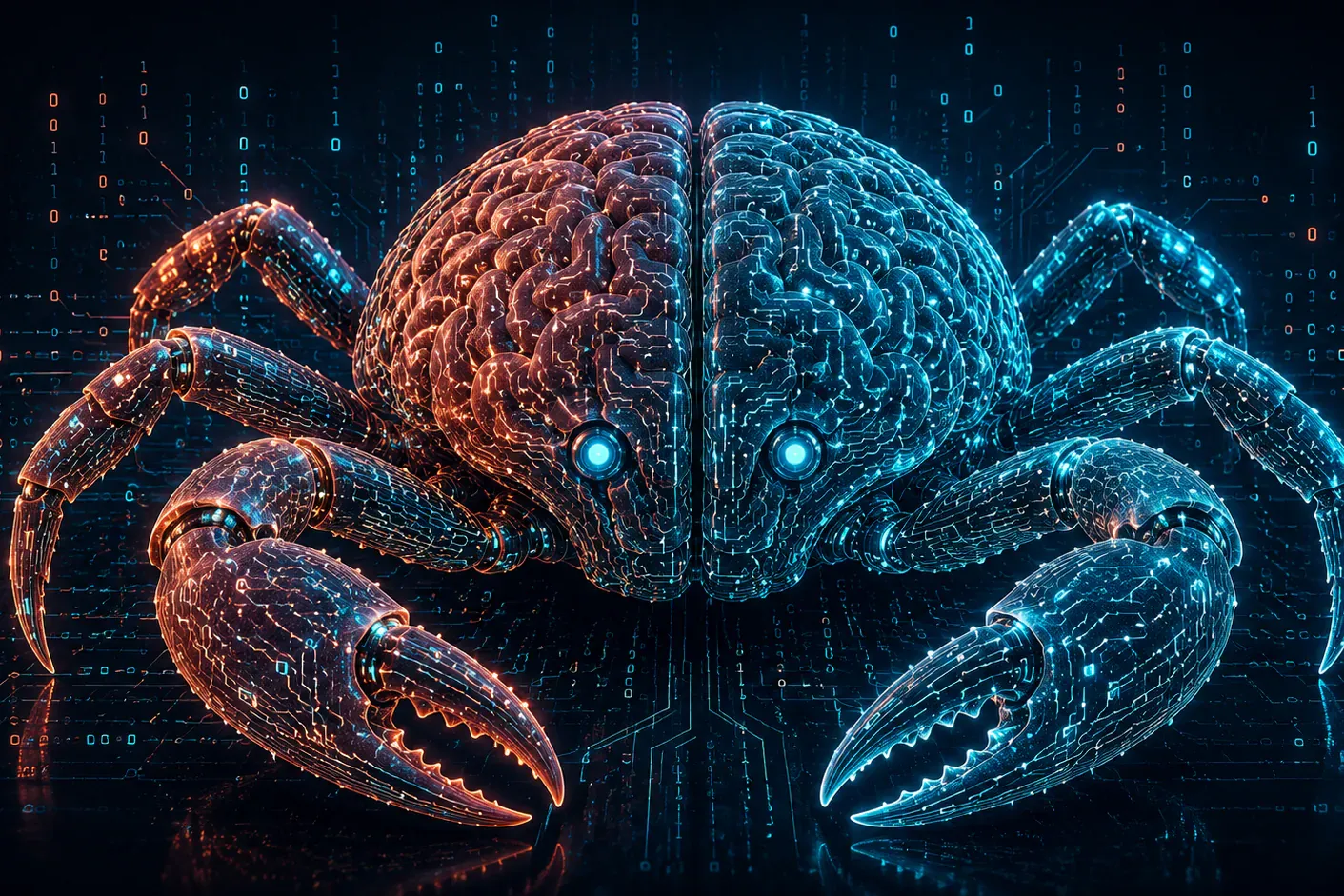
I won’t retell the video, and besides, they are a commercial company, so they have an interest in dressing up the achievements and the significance of their own AI. But it did push me toward an analogy with carcinisation - a particular case of convergent evolution in biology.
Crabs, eyes, and convergent evolution
Convergent evolution is the phenomenon where species that share no common ancestor independently develop similar traits, because they live in similar conditions. One of its most striking examples is carcinisation: crustaceans that are not true crabs evolve into a crab-like form over and over again. Put simply, the crab’s body plan is so well suited to its environment that nature keeps arriving at it by different routes. There is even a half-joking scientific hypothesis on the subject: if life exists on other planets and the conditions there resemble Earth’s, there will be creatures resembling crabs there too.
Another example is the eye. Mammals and octopuses diverged on the evolutionary tree long before complex eyes appeared, yet both branches independently developed a camera eye with a lens. In octopuses it is even better in some ways: their retina is not “inverted” - the nerve fibres run behind the photoreceptors rather than in front of them, so they have no blind spot. But that’s another story.
Language as an adaptation
Now let’s get back to artificial intelligence, or more precisely to LLMs - the large language models that Claude is built on. You can argue about it for a long time, but our language is first and foremost an adaptation to an environment. It gave us an enormous survival advantage: being physically far weaker than other mammals, and especially than predators, we still managed to survive and develop. The knowledge we pass on through language let us build better and better tools, which cancel out other species’ physical advantage over us. A mammoth may be far bigger than us, but the knowledge passed from hunter to hunter about how to make a spear and how to use it turned out to be a superb evolutionary advantage.
At their core, LLMs try to predict the next fragment of text. Just as our mind adapted to the physical world, an LLM adapts to its own - the world of text. We have different goals and different environments, but as with carcinisation, LLMs and the human mind have arrived at similar traits. Not because they are the same (I don’t consider an LLM conscious in the human sense of consciousness), but because systems with similar tasks converge over time on the same optimal solutions. An optimal solution stays optimal regardless of who finds it.
Where the bees come in
Optimal solutions? It sounds far-fetched, but it isn’t. Take a honeycomb. The shape of the cell is a regular hexagon. Why a hexagon? Because out of all the ways to divide a plane into cells of equal area, the hexagonal grid gives the smallest total wall length - that is, the least wax for the same volume. This is the honeycomb conjecture, finally proved by Thomas Hales in 1999. So does that make bees some kind of super-intelligent creatures who know geometry? No. It’s just that the bees which built more efficient combs spent fewer resources, survived, and passed their genes on.
The inner voice as an optimal form
Coming back to LLMs, you could say they have developed something resembling an inner voice, because that is the optimal form for working with text. In the same way, the human mind developed an inner voice because that is the optimal form for shaping a thought, passing it on to someone else, surviving in the savannah or the forest, and carrying knowledge to the next generation. Those who couldn’t do it didn’t survive. LLMs are trained on a similar principle. Very crudely, the models that were worse at predicting text never made it into the final version. It’s just that their environment isn’t the savannah - it’s text and people.
So the expected outcome is that an LLM will form something resembling an inner voice. It isn’t our inner voice, but it is something moving toward it in shape.
But you know what the most interesting part is? If this really is the case, and not just wishful thinking on my part, then it means that other planets could give rise not only to creatures resembling crabs, but to creatures with an inner voice resembling ours.

Alex Turchyn
Software engineer. Somewhere between null and reality.